Friday, June 24, 2011

The Girl from Junchow

Courtesy of Amazon.com
The Girl from Junchow is the conclusion of a trilogy written by Kate Furnivall. The trilogy focuses on a mother and daughter, Valentina and Lydia Ivanova, who are trying to make a living during the rise of Communism in both China and Russia. Valentina, a member of the Russian aristocracy, falls in love with an architect and risks everything in order to be with him. However, when the Revolution overtakes Russia the two are separated and Valentina is forced to survive along with her young daughter, Lydia. This signals a downward spiral of depression and alcoholism for Valentina. Many years later Lydia meets her own true love in the form of Chang An Lo, a young Chinese communist. However, their love is complicated by his communist beliefs and the difficulty of relationships between races.
The Girl from Junchow finds Lydia in Soviet Russia attempting to find her long lost father. Along the way she makes new friends and enemies while also trying to determine what to do about her love for Chang An Lo.
I found the story very well written, but also quite touching. Lydia makes a wonderful protagonist, because she is so complicated and damaged. She is also struggling with the problem of being with the person who she really loves while at the same time not endangering him. The idea of endangered ones loved ones is fully explored in this novel as Lydia comes face to the face with the fact that her sometimes reckless actions may unintentionally hurt the people who are most important to her. On a personal note I enjoyed the way in which the series as a whole discussed the changes that the Russia Revolution and the rise of Communism brought to the Soviet Union. As someone with family from that area the topic was very relevant, as it showed the consequences not only for the nation as a whole but for individual persons, many of whom had done no wrong.


For more information on Kate Furnivall and her work, visit her website http://www.katefurnivall.com/

Thursday, June 16, 2011

Cleopatra's Daughter

Cleopatra's Daughter is another excellent book by Michelle Moran. It tells the story of Cleopatra Selene, the only daughter of Queen Cleopatra, Egypt's most famous queen. The story begins with the aftermath of Cleopatra's defeat in the Battle of Actium and follows Selene and her twin, Alexander, as they attempt to adopt to their new life in Rome under the protection of Octavia, Augustus' beloved sister.
Courtesy of Michelle Moran
This is a well written tale  that gives a reader a feel for the time, but at the same time it is easy to relate to the homesickness and loneliness of the novel's heroine, Cleopatra Selene. Moran also focuses on the relationships of the key players in Roman history as well as exploring the difficult journey from childhood to adulthood.  Much like Moran's previous novels, The Heretic Queen and Nefertiti, the reader is able to explore the life of a strong female, historical figure and live through some major historical events 

Tuesday, May 31, 2011

Roosevelt House

Courtesy of Hunter College
Located on 47-49 East 65 Street in New York City, the Roosevelt House was once home to one of the greatest American presidents, Franklin Delano Roosevelt. The house was purchased for Franklin and his wife, Eleanor, by Franklin's mother, Sara. Although from the outside it looks like one house, in reality it was two separate homes, one for Franklin and Eleanor and the other for Sara. The house served as the Roosevelt's primary residence in New York City and this was were the president recovered after contracting polio. Shortly after the death of Sara Delano Roosevelt the house was put on sale and was ultimately purchased by Hunter College and named the Sara Delano Roosevelt Interfaith Memorial House, in honor of the president's deceased mother who had been a great supporter of interfaith tolerance and understanding. The house served as a gathering place and wedding hall for many Hunter students and the first lady, Eleanor Roosevelt, would often visit. Hunter would establish very close relations with the Roosevelts and in fact Eleanor would speak at Hunter several times and establish a great friendship with the president of Hunter College, Dr. George Schuster. The Roosevelt House was forced to close in 1992 due to the house having fallen into disrepair. It has only reopened last summer and is now home to Hunter College's Public Policy Institute. At the same time, the house remains a historic monument and tours are being given which discuss Roosevelt life in the house.


For more information on the Hunter College Public Policy Institute visit:

http://www.roosevelthouse.hunter.cuny.edu/

Helen of Troy: Goddess, Princess, Whore

Bettany Hughes' Helen of Troy takes an interesting approach to the legendary heroine. Using our knowledge of the Bronze Age, the time during which the legendary Trojan War would have taken place, she tries to reconstruct the real Helen. In this book, Hughes reveals a powerful royal woman who was central to a society where the right to rule was passed down through the female line and where woman were held to be sacred. Bettany Hughes also discusses in great detail the difference between the modern notion of the helpless captive who was stolen by a Trojan prince and the more realistic sovereign woman who chose a better catch. Hughes also examines the politics of the time and suggests that the legendary Trojan War may have been based on a real conflict fought not only over a woman but in order to bring down an extremely wealthy eastern province, perhaps even starting the eternal feud between East and West.
Courtesy of Amazon.com
This book is extremely well written with its descriptions bringing the Bronze Age to life. Furthermore, Hughes presents various perspectives creating a well rounded narrative while at the same time presenting a clear hypothesis. It is interesting to see Helen portrayed as a powerful female as opposed to the play thing of powerful men seen in Hollywood films such as Troy. I highly recommend this book, but for those who would prefer to watch rather than read about Helen of Troy Bettany Hughes has made a documentary called Helen of Troy which can be watched on PBS

Thursday, May 12, 2011

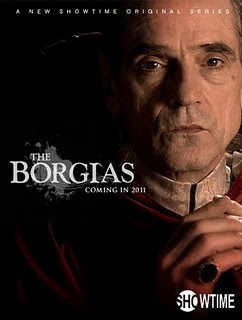
The Borgias

Courtesy of Showtime
Just got back from a wonderful vacation in Italy and have begun to watch Showtime's new series, The Borgias. I believe that just like with The Tudors Showtime has done a good job making history as enjoyable as possible. The Borgias focuses on the papacy of Pope Alexander or Rodrigo Borgia. The Borgia family became infamous for poisoning its enemies and it's mob like mentality. In fact, some have even gone so far as to say that the Borgias were the original mafia. Whether or not this is true, the show does focus on the sinfulness of the time with both the Pope and his son Cardinal Cesare enjoying numerous love affairs. There is plenty of blood, but in my opinion it serves a purpose and is not just used for effect. While it is true that the story does not always stick with historical fact some license must be given to the fact that The Borgias does not claim to be a documentary, but a drama. It is exciting and perhaps will encourage its viewers to examine the time period more closely. The actors are great, it seems like they have truly immersed themselves into the period. Overall, this new show has my support and will hopeful continue to live up to its expectations.

Saturday, March 19, 2011

Camelot

Courtesy of Starz
Starz is soon going to release their new TV series, Camelot. It seems that they are trying to reconcile the legend with real life. Based on trailers and interviews this one is not the idealistic view of a perfect king and ideal knights. Instead, the viewers see a brutal war, love and human flaws. Hopefully, this one will try to stick to a more historic Britain of Arthur's time, not the knightly Britain of the medieval war. Afterall, Arthur was no chivalrous knight. If he did indeed live, he was probably a warrior chieftain, more worried about survival and probably more brutal than the legends. Only time will tell if this show does justice to the top, but it is showing signs of being a very interesting adaptation.

Saturday, March 5, 2011

The Spanish Ballad or the Jewess of Toledo

Lion Feuchtwanger's historical fiction tells the story of a young woman, Raquel, a Jewess, who becomes the beloved of the Spanish king Alfonso. However, their story is not meant to have a happy ending. As discontent over a dreadful defeat rises the citizens of Toledo turn on Raquel and her father Yehuda, the king's financer. The two are murdered as they await the king's return.

The Jewess of Toledo shows how one woman is able to change a king. At the beginning of the story Alfonso is a proud knight, a courageous, but foolish king. He can only think of war, not what is best for his people. However, love for Raquel changes him, makes the king see peace as a good thing. Unfortunately, his jealous wife uses his knightly pride to force Alfonso into a war he can't win. Sadly, Alfonso is truly able to become a great king only after he has lost his only love, Raquel. He death leaves him hallow, but able to posses the patience and prudence necessary to be a good king to his people.
Courtesy of geometry.net
A truly moving tale, The Jewess of Toledo is a must read. Unlike many older books it is neither stuffy or boring. It is highly descriptive and the language is very accessible. I highly recommend it.