 |
| Courtesy of Karen Harper |

Blog dedicated to sharing fun tidbits about history and reviewing both historical fiction and non fiction books * comments are greatly appreciated
Thursday, August 25, 2011
The First Princess of Wales
The First Princess of Wales is one of my favorite books. It is the love story of Joan of Kent and Prince Edward, famously known as the Black Prince of Wales. The story begins with a young Joan leaving her childhood home in order to become a ward of the Queen, her distant relative. Newly arrived at court Joan unknowingly meets the Prince of Wales thus sparking a love story that would survive for hundreds of years.
The novel is beautifully written and the reader easily falls in love with Joan. One can readily relate to her free spirit and her internal struggle between love and revenge. At the same time Prince Edward is a noble love interest, truly devoted to Joan if at times misguided in his efforts to win her love. Although the story first brings to mind the late Princess Diana, on further reflection it is possible to see how the author may have been inspired by the true love story of Camila Parker Bowles and Prince Charles. Their love may have not been as glamourous, but proved to be more lasting than his marriage with the late Princess Diana. Just like Charles and Camilla, Edward and Joan face many obstacles including parental disapproval, but were ultimately able to have their happily ever after.

Tuesday, August 9, 2011
The Irish Princess by Karen Harper
 |
| Courtesy of Barnes and Noble |
 | ||
| Courtesy of Wikipedia |
Furthermore, the story itself seems to jump around. While it is perfectly natural for a prologue to take place at a later time than the first chapter it is very strange that within one paragraph the story jumps years into the future with no explanation or a character ends up in a place with no account as to why she is there.
Overall, The Irish Princess could have been better, but does give some glimpse into the power players of the Tudor period.
Friday, June 24, 2011
The Girl from Junchow
 |
| Courtesy of Amazon.com |
The Girl from Junchow finds Lydia in Soviet Russia attempting to find her long lost father. Along the way she makes new friends and enemies while also trying to determine what to do about her love for Chang An Lo.
I found the story very well written, but also quite touching. Lydia makes a wonderful protagonist, because she is so complicated and damaged. She is also struggling with the problem of being with the person who she really loves while at the same time not endangering him. The idea of endangered ones loved ones is fully explored in this novel as Lydia comes face to the face with the fact that her sometimes reckless actions may unintentionally hurt the people who are most important to her. On a personal note I enjoyed the way in which the series as a whole discussed the changes that the Russia Revolution and the rise of Communism brought to the Soviet Union. As someone with family from that area the topic was very relevant, as it showed the consequences not only for the nation as a whole but for individual persons, many of whom had done no wrong.
For more information on Kate Furnivall and her work, visit her website http://www.katefurnivall.com/
Thursday, June 16, 2011
Cleopatra's Daughter
Cleopatra's Daughter is another excellent book by Michelle Moran. It tells the story of Cleopatra Selene, the only daughter of Queen Cleopatra, Egypt's most famous queen. The story begins with the aftermath of Cleopatra's defeat in the Battle of Actium and follows Selene and her twin, Alexander, as they attempt to adopt to their new life in Rome under the protection of Octavia, Augustus' beloved sister.
This is a well written tale that gives a reader a feel for the time, but at the same time it is easy to relate to the homesickness and loneliness of the novel's heroine, Cleopatra Selene. Moran also focuses on the relationships of the key players in Roman history as well as exploring the difficult journey from childhood to adulthood. Much like Moran's previous novels, The Heretic Queen and Nefertiti, the reader is able to explore the life of a strong female, historical figure and live through some major historical events
 |
| Courtesy of Michelle Moran |
Tuesday, May 31, 2011
Roosevelt House
 |
| Courtesy of Hunter College |
For more information on the Hunter College Public Policy Institute visit:
http://www.roosevelthouse.hunter.cuny.edu/
Helen of Troy: Goddess, Princess, Whore
Bettany Hughes' Helen of Troy takes an interesting approach to the legendary heroine. Using our knowledge of the Bronze Age, the time during which the legendary Trojan War would have taken place, she tries to reconstruct the real Helen. In this book, Hughes reveals a powerful royal woman who was central to a society where the right to rule was passed down through the female line and where woman were held to be sacred. Bettany Hughes also discusses in great detail the difference between the modern notion of the helpless captive who was stolen by a Trojan prince and the more realistic sovereign woman who chose a better catch. Hughes also examines the politics of the time and suggests that the legendary Trojan War may have been based on a real conflict fought not only over a woman but in order to bring down an extremely wealthy eastern province, perhaps even starting the eternal feud between East and West.
This book is extremely well written with its descriptions bringing the Bronze Age to life. Furthermore, Hughes presents various perspectives creating a well rounded narrative while at the same time presenting a clear hypothesis. It is interesting to see Helen portrayed as a powerful female as opposed to the play thing of powerful men seen in Hollywood films such as Troy. I highly recommend this book, but for those who would prefer to watch rather than read about Helen of Troy Bettany Hughes has made a documentary called Helen of Troy which can be watched on PBS
 |
| Courtesy of Amazon.com |
Thursday, May 12, 2011
The Borgias
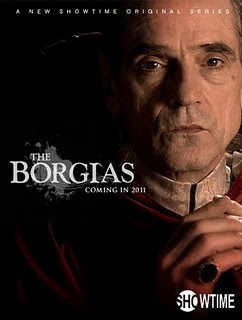 |
| Courtesy of Showtime |
Subscribe to:
Posts (Atom)